What is an HS Code? A Guide for Logistics Teams (2026)
What is an hs code and why does it matter? Our guide explains the HS code system, how to classify goods for customs, and how to avoid costly compliance errors.
A shipment is packed, labelled, booked, and moving on schedule. Then customs stops it. The commercial invoice looks fine. The packing list is there. The carrier says the issue is “classification”. Operations hears that word and usually translates it into delay, extra emails, and a broker asking for more detail that should have been captured days earlier.
That's where it becomes vital to understand what is an hs code, and why such a small string of numbers determines whether goods move cleanly or get stuck.
In practice, an HS code isn't admin trivia. It's the product language customs systems use to decide what your goods are, what rules apply, and what else they need before clearance. The code used on a declaration doesn't just describe the goods. It can shape duty, VAT treatment, licensing checks, and whether someone at the border wants a second look.
The frustrating part is that a lot of guidance stops at a textbook definition. That's not enough when your team is working on classifying hundreds or thousands of item descriptions, inheriting old codes from outdated sources and trying to keep declarations moving without turning every shipment into a customs research project.
This guide treats HS codes the way operations teams experience them. As a workflow problem, a data quality problem, and a risk control problem. If you're managing imports, exports, fulfilment, brokerage support, or customs data inside a UK business, this is the practical version.
Table of Contents
Introduction to the Universal Language of Global Trade
The Harmonized System, or HS, gives customs authorities a shared framework for identifying goods across borders. The World Customs Organization maintains the international structure at the 6-digit level, and each country builds its own tariff codes on top of it. In the UK, that distinction matters. Teams often say "HS code" as shorthand, but the operational job usually requires the correct UK commodity code for the movement you are making.
That gap between global terminology and UK declaration reality causes a lot of avoidable errors. A supplier may send a code that works in another market. An ERP record may hold an old reference that was never reviewed after a product change. An operations team may describe the item one way, while customs needs a classification based on material, function, and legal notes.
The UK context has made this more operational, not less. Since Brexit, businesses moving goods between the UK and the EU have had to treat customs data as a live process rather than a background admin task. HS revisions also continue over time, and national tariff extensions change with them, so a code that was accepted years ago should not be treated as permanent. Merana Group notes that the HS system has been revised in regular cycles since its introduction, which is one reason classification governance matters in day-to-day trade work, not just during audits: https://merangroup.com/what-is-hs-code-everything-about-it-comprehensive-explanation/
For operations managers, that is the practical starting point. HS codes are part of a workflow. They need to be found, checked, recorded, reviewed, and updated as products and rules change. Teams that still handle classification as a one-time lookup usually end up missing preventable mistakes under deadline pressure.
What an HS Code Is and Why It Matters
An HS code is the standard classification used to identify traded goods for customs purposes. The easiest way to explain it to a new operations manager is this. It works like a product passport. Not because it tells customs everything, but because it tells customs where to start and which rulebook to open.
Why customs cares about the code
The code affects practical outcomes, not just classification neatness.
Duty treatment: The tariff code determines whether goods are dutiable and what tariff treatment applies.
Controls and restrictions: Some classifications trigger extra document checks, import controls, or other requirements.
Declaration accuracy: The code is required data in import and export customs processes.
Trade statistics: Governments also use classification for reporting and statistical analysis.
If your team gets the code wrong, the downstream problems usually look familiar. Unexpected charges, queries from customs brokers, rejected declarations and paperwork, border delays, internal disputes over who approved the original code before applying it to the customer's account. None of that is abstract. It shows up in service levels and eventual margin.
Why generic definitions don't help enough in the UK
A lot of content answers “what is an hs code” with a global explanation and stops there. That's where many UK teams get tripped up. In the UK, importers generally need a 10-digit commodity code for imports and an 8-digit code for exports, built on the international 6-digit HS foundation. The extra digits matter because duty rates, import controls, and statistical reporting can change after the first six digits, as explained in ALS Customs Services' overview of HS and HTS coding.
That means a generic HS lookup can point you in the right direction, but it doesn't finish the job for UK declarations.
Practical rule: If your team stops at the first six digits, you've usually identified the product family, not completed UK customs classification.
What the code is not
It's not a product SKU. It's not a supplier reference. It's not something you should copy from an old invoice without checking whether the product, destination, or tariff treatment still matches.
A strong classification process asks customs questions, not catalogue questions. What is it. What is it made from. What is its main use. Is it complete, unfinished, mixed, or packed with something else. Those are the questions that lead to reliable codes.
For logistics and operations teams, that's the shift that matters. Treat HS coding as a business control. Not as a field you fill in at the end because the software asked for it.
Decoding the HS Number Structure
The number looks cryptic until you break it apart. Once you do, it becomes much easier to see why two products that seem similar in a catalogue can land in different tariff positions.
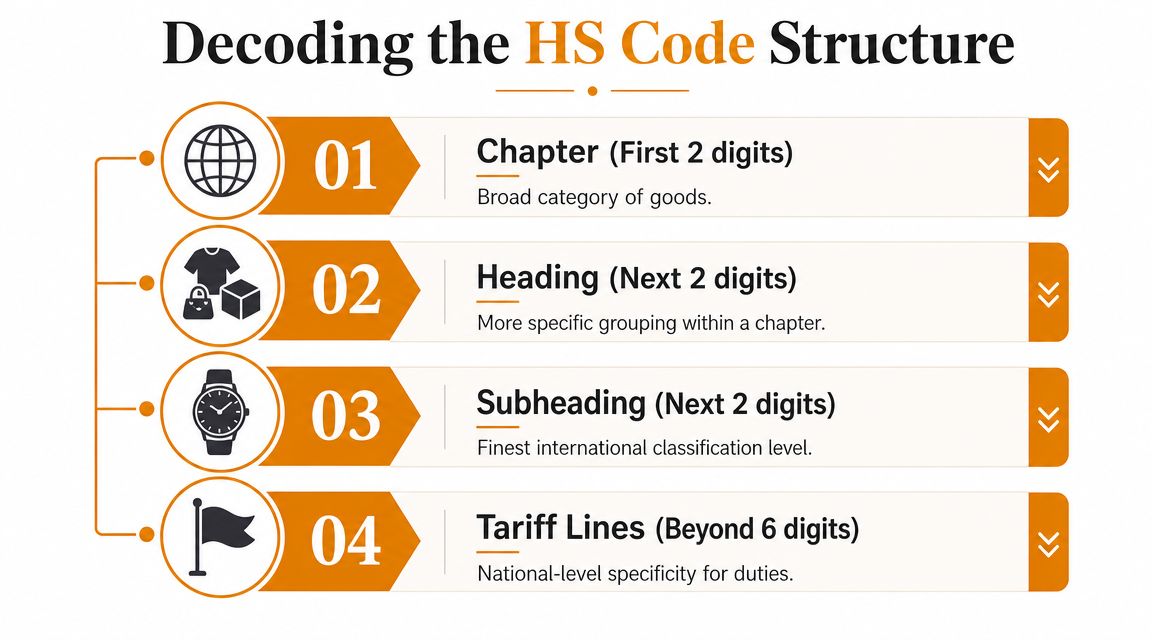
At the international level, the HS is built around a 6-digit structure. Each pair of digits narrows the description.
The first six digits
Think of the code as moving from broad to specific.
| Part | What it means | Operational use |
|---|---|---|
| First 2 digits | Chapter | Broad category of goods |
| Next 2 digits | Heading | More specific product grouping |
| Final 2 digits | Subheading | Finest international classification level |
A simple way to explain this internally is to compare it with a warehouse location hierarchy. You start with the aisle, then the bay, then the shelf. The HS does something similar for moving products.
Why the structure matters in real classification
Take a common item example like footwear. A customer service team member might think “shoe” is enough. It isn't. Classification can change depending on what the upper is made from, what the outer sole is made from, and whether the item belongs in a more specific subgroup. A leather shoe and a textile trainer may sit in different places even though both are sold as shoes.
That's why weak product data causes weak classification. If the item master says “ladies casual trainer”, you still don't know enough. Customs logic needs material and construction detail, not retail wording.
Where the UK adds complexity
The 6-digit HS code is the global base. The UK extends beyond that for tariff and declaration use. For UK operators, this is the part many global explainers skip.
In the UK, the tariff system adds national detail after the international six digits. That extra detail is what turns a broad global classification into something usable for duty collection, customs clearance, and reporting. The practical distinction is straightforward:
Imports into the UK generally need a 10-digit commodity code
Exports from the UK generally use an 8-digit code
Both are built on the same 6-digit HS foundation
The first six digits may align globally. The full UK code may not.
If someone says “we already have the HS code”, the next question should be “do we have the right UK commodity code for this movement”.
How to Classify Your Goods Correctly
Start with the product, not the paperwork
If you are classifying a new item, pause before searching the tariff and collect the facts that change the result.
- 1
Define the product in plain technical terms
Write down what it is, what it does, and what it is made from. “Wireless accessory” tells customs very little. “Rechargeable Bluetooth speaker with plastic housing and integrated battery” gives you a usable starting point. - 2
Identify what gives the goods their character
Classification often turns on the feature that drives the product's function or identity. For mixed goods, that is not always the highest-value part. Material, role, and how the goods are presented for sale can all matter. - 3
Check whether the goods are unfinished, complete, or packed together
On this point, teams often lose time and money. Spare parts, kits, multipacks, and retail sets need separate analysis. The sales name on the box does not decide the tariff position. - 4
Use tariff language, not sales language
Marketing descriptions are written to attract buyers. Tariff schedules are written to separate one category of goods from another. If your search terms come from a product page, your first result is often the wrong one.
Build a record your team can defend
A code on its own is not enough. If HMRC, a broker, or an internal auditor asks why that code was used, someone should be able to pick up the file months later and follow the reasoning without guessing.
A usable classification record should include:
The customs-facing product description
Material composition and primary function
Technical sheets, drawings, or supplier specifications
The code selected and the reasoning behind it
Who approved the decision and when it was last reviewed
This matters even more in UK operations, where teams often mix up a global HS starting point with the code needed for the declaration itself. A disciplined record keeps that distinction clear and makes reviews faster when product specs, suppliers, or tariff wording change.
Spreadsheets and email chains can work for a small SKU set. They usually fail once the catalogue grows, staff change roles, or products evolve over time. If you need a structured way to store decisions, compare likely matches, and keep the rationale attached to each SKU, Dutiful's classification feature is built for that workflow.
The goal is a classification decision another trained person can review and support, not a code copied from the last shipment.
Here's a practical explainer if you want to see the underlying logic discussed visually:
Common mistakes that keep causing problems
Some errors show up repeatedly in classification reviews and post-clearance checks.
Using the supplier's code without testing it
Supplier data is useful input, not a final answer. The code may reflect another country's tariff treatment, an older revision, or a simplified classification used for internal shipping documents.Classifying by product name alone
Terms like “case”, “bag”, “device”, or “accessory” are too broad to support a defensible decision. Customs needs the physical and functional details.Ignoring engineering or sourcing changes
A switch from textile to leather, manual to electric, or standalone to bundled can change the classification outcome.Treating old ERP data as settled truth
Legacy codes create false confidence. If nobody stored the reasoning, nobody knows whether the code is still right.Overlooking sets and composite goods
Gift packs, repair kits, and bundled ecommerce items often need a closer reading of the rules than single-item products do.
What works better in practice
Teams usually improve classification accuracy by standardising a few operating habits and making ownership clear.
| Weak habit | Better habit |
|---|---|
| Copying codes from prior shipments | Checking the current product specification before reuse |
| Letting each department describe goods differently | Maintaining one customs-ready description |
| Storing only the final code | Storing the code, rationale, and supporting documents |
| Reviewing only after a customs query | Reviewing when products, suppliers, or tariff rules change |
Use a simple test. Ask, “If our customs lead left tomorrow, could someone else defend this code from the file alone?” If the answer is no, the process is still too fragile.
Finding and Verifying HS Codes in Your Workflow
Manual lookup versus integrated data
Manual classification research still has a place, especially for edge cases. But it creates predictable problems at scale.
| Manual approach | What usually goes wrong | Better alternative |
|---|---|---|
| Searching tariff sites by keyword | Search terms reflect sales language, not tariff logic | Use structured product attributes |
| Reusing broker emails | Reasoning gets lost and decisions become person-dependent | Store decisions in a system of record |
| Copying supplier codes | Foreign tariff logic may not match UK needs | Validate against UK-specific requirements |
| Keeping static spreadsheets | Nobody knows what needs review | Use data that can be updated and monitored |
Classifications don't stay still. The HS is revised every five years, and the international HS 2022 update introduced new headings for e-commerce, environmental goods, and emerging technologies. Businesses need to re-check legacy classifications because a code once assigned may not remain valid indefinitely, as explained in UPS's glossary note on HS code updates.
That single point changes how to advise teams to manage classification. Don't treat lookup as a one-time task. Treat it as maintained data.
What a workable process looks like
A practical workflow usually has four parts.
Intake: Capture product facts in a standard format before anyone searches for a code.
Decision: Match the goods to the most defensible classification using current tariff data.
Verification: Check whether the code works for the relevant country and movement type.
Maintenance: Revisit classifications when products change, rules change, or sourcing changes.
For software teams and high-volume operations, APIs are often the cleanest way to avoid hand-built customs logic in multiple systems. If you need classification and customs checks inside checkout, booking, or internal operations tools, Dutiful's customs API is built for that style of workflow.
The question isn't whether your team can find a code manually. It's whether you can find, verify, reuse, and review that code without depending on one experienced person's inbox.
The biggest operational improvement usually comes from joining classification to the rest of your customs process. Once the code is part of a verified data layer, teams can connect it to document requirements, restrictions, and route-specific checks instead of treating it as a standalone number.
If your team is still answering “what is an hs code” only after a shipment is held, the control point is too late. Dutiful gives operations and developer teams a way to work from verified customs data before goods move, whether that means using Assist for guided research or joining the waitlist to see how the API fits into your existing workflow.