Shipping to Ireland from UK: Your 2026 Customs Guide
Your complete guide to shipping to ireland from uk in 2026. Understand post-Brexit customs, VAT, EORI numbers, required documents, and carrier rules for smooth
You've probably seen this happen already. A team books a routine-looking shipment from Manchester to Dublin, prints a label, hands it to the carrier, and assumes it will move like pre-Brexit traffic. Then customs stops it. The invoice is vague, the value doesn't match the contents, the origin field is missing, and nobody decided in advance whether the shipment was going DDP or DDU.
That's the new baseline for shipping to Ireland from UK operations. The route is still commercially important and physically short. It is no longer administratively simple. If you're moving goods from Great Britain into the Republic of Ireland, you're handling an export into the EU, and the difference between a smooth delivery and a held shipment usually comes down to paperwork quality, product classification, and whether your team understood which Ireland the goods were going to.
Table of Contents
The New Reality of Shipping from the UK to Ireland
A warehouse team clears a same-day backlog for Dublin, books the carrier, and assumes the hard part is over. By the time the freight reaches the port, a significant problem shows up. The goods can move, but the paperwork cannot.
That is the post-Brexit reality for shipping to Ireland from UK operations. Delays now start earlier, usually at order creation, item setup, or dispatch approval. Teams still get caught when they treat the route as operationally close even though customs treats it as a controlled cross-border movement.
Ireland remains one of the UK's biggest export markets. This volume means it is not a side lane for occasional parcels. It is a high-frequency trade corridor where small process mistakes repeat across hundreds or thousands of consignments.
The route is busy, and errors scale fast
For operations teams, the practical change is simple. A shipment to Ireland is no longer just a transport booking. It is a transport booking plus customs data, tax treatment, and destination-specific rules. That last point gets missed too often. Belfast and Dublin can sit in the same planning view, but they do not follow the same handling logic. One requires a full customs declaration, one requires parcel data.
The teams that stay out of trouble ask a better question before pickup: is this shipment release-ready? Speed only helps once the data, commercial terms, and destination setup are correct.
Practical rule: If the item description, origin, value, consignee details, and charging model are still unsettled before dispatch, the shipment is not ready.
This gets more important for e-commerce, relocation shipments, and high-return categories such as cosmetics, supplements, electronics, and other restricted or review-heavy goods. Those shipments create more exceptions, more customer contacts, and more cost if the first submission is weak. Returns make it worse. A product that was sent out with poor classification or unclear value often comes back through an equally messy process.
The expensive mistakes usually start upstream
In operations reviews, the repeat issues are usually these:
Domestic-style paperwork: teams send a basic invoice, picking slip, or order confirmation instead of a commercial invoice or proforma built for customs use
Descriptions with no customs value: terms like “accessories”, “samples”, or “parts” do not tell customs what the goods are
No Republic of Ireland versus Northern Ireland split in the workflow: staff book by postcode or city name without applying the right compliance path first. Since Brexit and the consequential introduction of the Windsor Framework, both destinations require paperwork, but not necessarily the same kind.
Late charge decisions: nobody fixes who will pay duties, VAT, and clearance-related costs until the shipment is already moving
Each one creates a predictable result. The carrier moves the freight. Clearance pauses it. Customer service gets pulled in. Margin disappears through admin time, storage and refunds.
Teams now need to treat Ireland as a rules-driven lane, not a familiar extension of the UK network. Build destination logic into the order flow early. Separate Northern Ireland from the Republic of Ireland before client information is requested and labels are produced. If you are reviewing your cross-border setup this year, the coming EU de minimis removal in 2026 is another reason to tighten that process now.
If you run fulfilment, brokerage, relocation, or marketplace operations, pre-shipment checks are part of the job. The cost of skipping them shows up later, usually when the parcel is already at the border and the fix is slower and more expensive.
Navigating Post-Brexit Customs Duties and VAT
A courier van leaves Birmingham on time, reaches the port on time, and still misses its delivery window in Dublin. The transport leg was fine. The problem was set earlier, when nobody fixed the customs value, the goods description, or who would pay the charges on arrival.
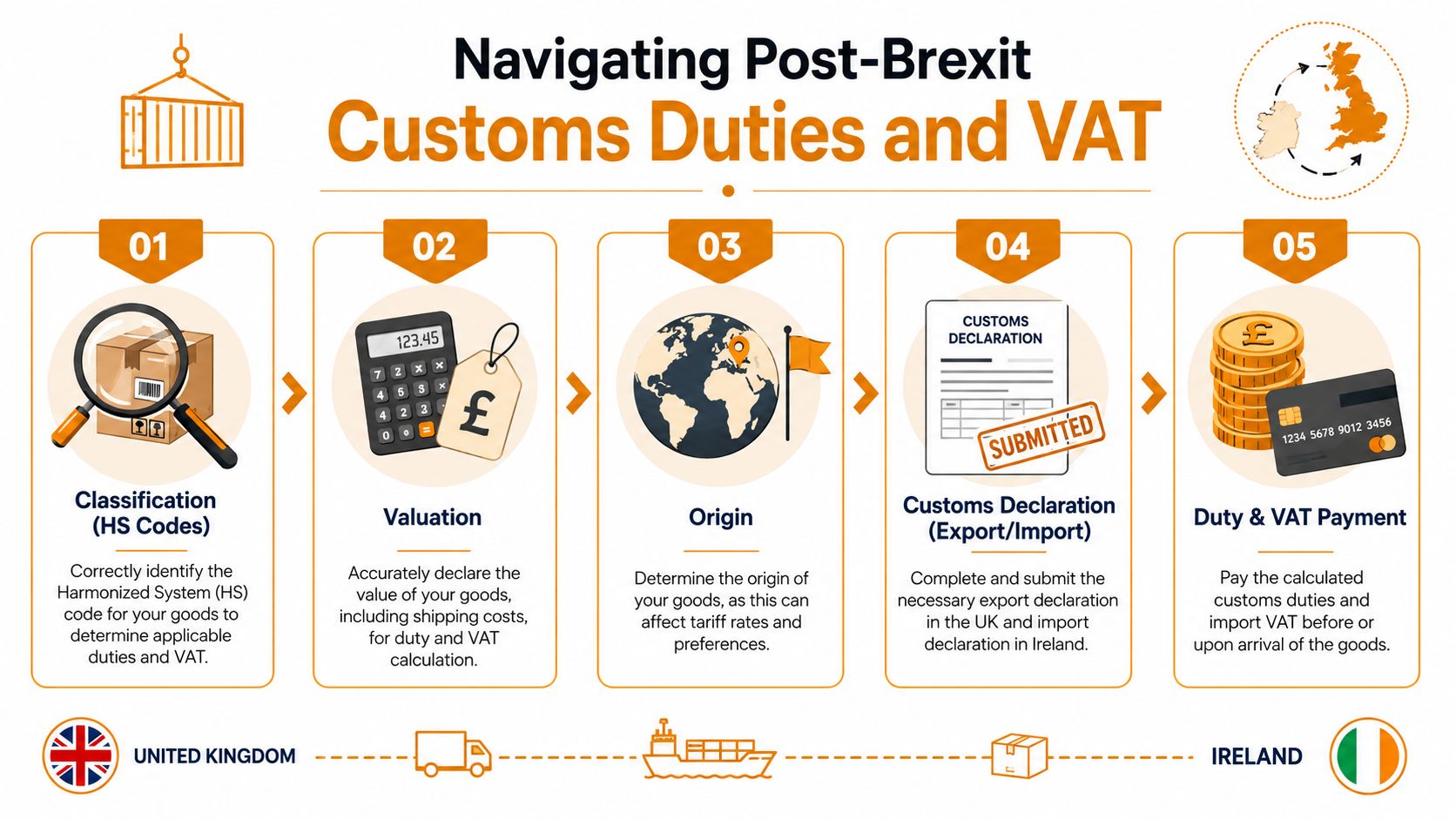
Why customs now sits inside the transport workflow
For shipments from Great Britain to the Republic of Ireland, customs clearance is built into the movement of goods. It is not a tidy admin step that can be patched in later. Parcel2Go's Ireland guide highlights the basics correctly. The proforma invoice and customs declaration need accurate descriptions, values, and origin data. If those fields are weak, the shipment is already at risk before collection.
Three controls drive most outcomes.
- 1
Classification
The commodity code shapes duty treatment, VAT handling, and how the carrier or broker submits the entry. Bad coding creates the wrong charges, the wrong documentation requirements, or a manual review. - 2
Valuation
The declared value has to reflect the transaction and the shipment type. Under-declaring to cut charges is a fast way to trigger checks. Over-declaring causes different problems, especially on insurance claims and customer disputes over landed cost. - 3
Origin
People often confuse country of dispatch with country of origin. Customs does not treat them as the same thing.
The Republic of Ireland and Northern Ireland start to diverge operationally. If your team handles Irish destinations through one shared process, duty and VAT errors become much more likely because the customs treatment is not the same.
The commercial decision that changes delivery performance
The shipping term matters as much as the paperwork. For many UK to Republic of Ireland flows, the avoidable delays come from choosing DDU but not explaining thoroughly enough to the consignee that they are responsible for any duties charged. If a client is unexpectedly hit with charges, they're either going to expect you to pay or they'll challenge them, leading to avoidable delays.
Parcel2Go explains the practical split clearly. Under DDP, the shipper pays duty and VAT upfront. Under DDU, the recipient is asked to pay before release. In operations, that difference shows up in customer service load, failed first delivery attempts, and parcels sitting in clearance while someone waits for a payment link whilst your customer service team's inbox gets fuller.
Use the term that matches the buyer and the shipment type.
DDP is usually the safer choice for B2C or C2C orders, time-sensitive deliveries, relocation consignments, and any shipment where the receiver is unlikely to manage customs charges smoothly.
DDU can work for experienced B2B buyers who already import into the Republic of Ireland and expect to handle duty, VAT, and clearance charges themselves. However it can also work for B2C or C2C where an agent assists the shipment and explains upfront that the client is to expect the bill.
VAT needs the same level of discipline. Ireland's standard VAT rate is 23%, but the operational point is in the question of relief. Standard shipments will be charged, including mixed shipments where customs cannot qualify the "used" in used personal effects. However if you're moving your residence to Ireland and your shipment meets criteria, this can mean 0% VAT and duty.
What effective operational teams do before booking
Effective operational teams build a release checklist before booking, and they use different logic for the Republic of Ireland and Northern Ireland.
Set the incoterm early: Clarify DPP v DDU - is this set on a client to client basis or does your organisation set a standard process that needs explaining to the consignee.
Match the value to the shipment purpose: Sale, return, replacement, sample, and personal effects do not all behave the same way.
Check the file fits "used personal effects": Have the items been clearly owned by the consignee for more than 6 months, have they lived outside of the EU for more than 12 months.
Flag restricted and prohibited items: Cosmetics, supplements, batteries, alcohol, and antiques create more customs friction than standard used items.
Review upcoming rule changes: If you rely on low-value parcel moved, prepare now for the EU de minimis removal in 2026.
The teams that keep this lane under control do one thing consistently. They treat customs, tax, and delivery promise as one operational process. That matters even more on UK-Ireland traffic because a workflow built for Northern Ireland can fail quickly when the destination is the Republic.
Your Essential Paperwork and Documentation Checklist
A shipment to Dublin can fail for a completely different paperwork reason than a shipment to Belfast. Teams that miss that distinction usually prepare one export document set and hope it works for both. It does not.
For the Republic of Ireland, customs documents must stand up on their own. For Northern Ireland, the process depends far more on the movement type, the carrier setup, and whether the goods are treated as staying within the UK internal market framework or moving under an arrangement that still needs additional data checks. Operations teams need a document rulebook by destination, not one generic Ireland workflow.
The Core Function of the Proforma Invoice
For goods moving from Great Britain to the Republic of Ireland, the proforma invoice is the document customs and the carrier use to decide what the goods are, how they should be classified, and what charges or controls apply. If the invoice is vague, every downstream step gets slower.
Descriptions like “clothing”, “home goods”, or “machine parts” are not good enough. A workable invoice tells customs what the item is, what it is made from where relevant, what it is used for, how many units are in the shipment, the value, and the origin.
For day-to-day operations, the invoice should include:
Shipper and receiver details: Full legal names and complete addresses.
EORI details where required: Check the populated number against the shipment type before release.
Precise goods descriptions: Use detail, not brief listings.
Declared value and currency: Match the used value to the reality of the shipment.
HS code: Has your operational workflow developed a HS code identifier?
Country of origin: Means the origin of the goods, not the dispatch location. ie if a used polyester wallet is from an Australian trip 5 years ago, the origin is Australia not GB.
An invoice is a customs document. It is not a packing note with prices added.
That distinction matters in returns and relocation shipments. If used personal goods are described like new retail stock, the shipment can be assessed under the wrong logic and routed into manual review with a hefty bill attached.
Checklist for documents that prevent holds
Before dispatch, validate the full document set against the destination and shipment purpose.
| Document / Data Point | Requirement | Common Mistake to Avoid |
|---|---|---|
| Proforma invoice | Must identify shipper, consignee, goods, value, currency, origin, and classification clearly | Using vague descriptions such as “parts” or “samples” |
| Customs declaration | Must match the invoice and reflect the shipment purpose accurately, signed by consignee | Mismatched values, quantities, or item descriptions |
| EORI details | Must be present where the movement requires customs processing | Assuming the carrier can fix a missing or wrong number after handover |
| Packing list | Should reflect the physical contents and carton structure | Sending large relocation paperwork with no box by box structure |
| Country of origin data | Must be correct for each relevant item line | Confusing ship-from country with origin of the goods |
| Duty/VAT payment method | Must be set before dispatch and aligned with the incoterm | Leaving DDP versus DDU unresolved until arrival |
| Address data | Must be complete and formatted for Irish last-mile delivery | Missing county, postcode data where applicable, or contact details |
A packing list becomes far more important when the shipment has multiple boxes, relocation contents, or products that attract inspection. It gives the carrier and customs a map of the freight they are looking at. Without it, one discrepancy in one carton can stall the whole consignment. If your consignee failed to list items, this will hold up the whole movement.
Three habits create repeat paperwork failures on this lane:
Copying domestic order data into export documents
Using limited or basic HS code look ups within your operating system, incorrectly listing items
Treating document completion as admin after packing, rather than ensuring the consignee accurately declares their data
We advise teams to review document quality on the shipments that generate the most support tickets. The pattern is usually clear. Republic of Ireland shipments fail on customs detail. Northern Ireland shipments fail when teams assume the same document logic applies in both directions or miss steps from the new requirement. Separate those workflows, tighten the invoice standard, and a large share of avoidable exceptions disappear.
Understanding Prohibited and Restricted Goods
The route attracts a lot of “cheap and quick” marketing. That's where teams get caught. A parcel can look easy to send until a single item pushes it into a restricted workflow.
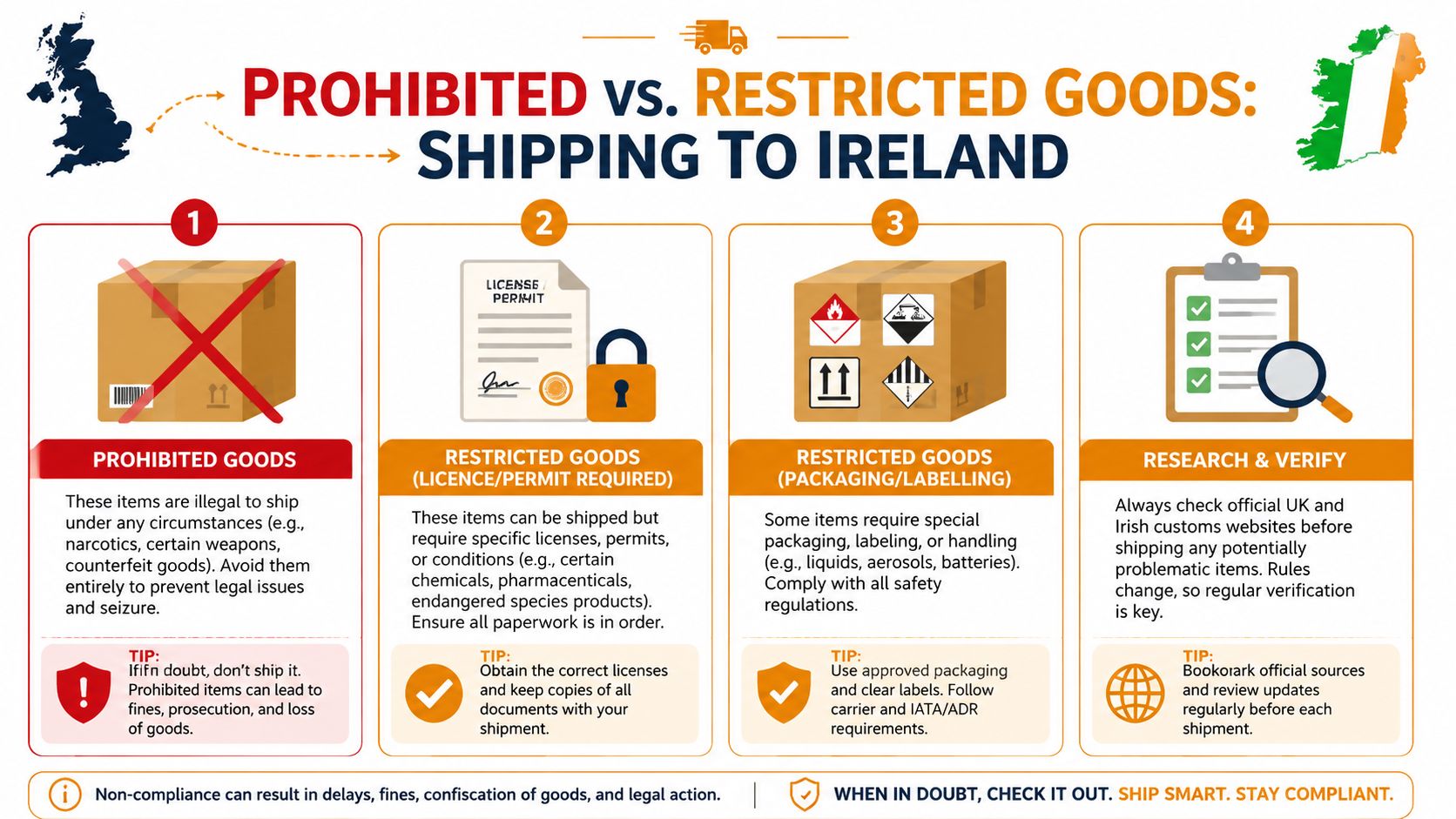
What usually goes wrong
The most important distinction is simple:
Prohibited goods can't be shipped through the service or into the destination under the relevant rules.
Restricted goods may be shippable, but only with specific conditions, documentation, approvals, packaging, or carrier acceptance.
The operational problem is that many of the goods causing trouble don't look unusual. ParcelBroker's Ireland page notes broad prohibitions and restrictions such as lithium batteries, perfumes and aerosols, alcohol, tobacco, cash, weapons, and passports or legal documents. It also highlights a practical gap many teams ignore. Common consumer goods like electronics with batteries and beauty products containing alcohol are high-risk for rejection even when courier pages market Ireland as fast and inexpensive.
That's exactly what happens in relocations. The booking succeeds. The item fails later.
The items to pre-check before booking
The goods that deserve extra scrutiny are usually the ones customers think are routine:
Battery-powered electronics: Phones, wearables, toys, tools, and accessories often carry battery restrictions that differ between domestic and international carriage.
Beauty and fragrance products: Perfumes, aerosols, and products containing alcohol often trigger dangerous goods or carrier-specific restrictions.
Alcohol and tobacco: These categories can create customs, excise, and carrier acceptance problems.
Documents and valuables: Passports, cash, and certain legal papers may be excluded or operationally risky.
Relocation mixed boxes: A box labelled “bedroom items” can easily conceal products with restricted components.
Key check: Don't ask only whether the item is legal to own. Ask whether your chosen carrier will accept it on that route, under that service.
There's another failure point that gets less attention: address quality. ParcelBroker also notes the importance of Eircode precision and, for some Dublin and Cork addresses, zone codes. A shipment can clear customs and still fail delivery if the address data is poor. This matters because different carriers issue a set number of delivery attempts before returning the entire shipment at your expense.
What works in practice
Before the customer checks out, before the relocation inventory is packed, and before the freight booking is confirmed, run a goods screening process that checks:
Item category
Prohibited item content
Carrier acceptance
Any permit or handling condition
Address completeness for Irish delivery
The mistake isn't shipping something obviously dangerous. The mistake is treating operationally fragile items as if they're ordinary export parcels.
Northern Ireland vs Republic of Ireland: A Critical Distinction
Your operating system receives two late afternoon shipments from Manchester. One goes to Belfast, one to Dublin. The items look similar, the route looks similar, and both are described internally as “Ireland”. By the next day, one is moving as expected and the other is stuck because the paperwork and process were built for the wrong destination.
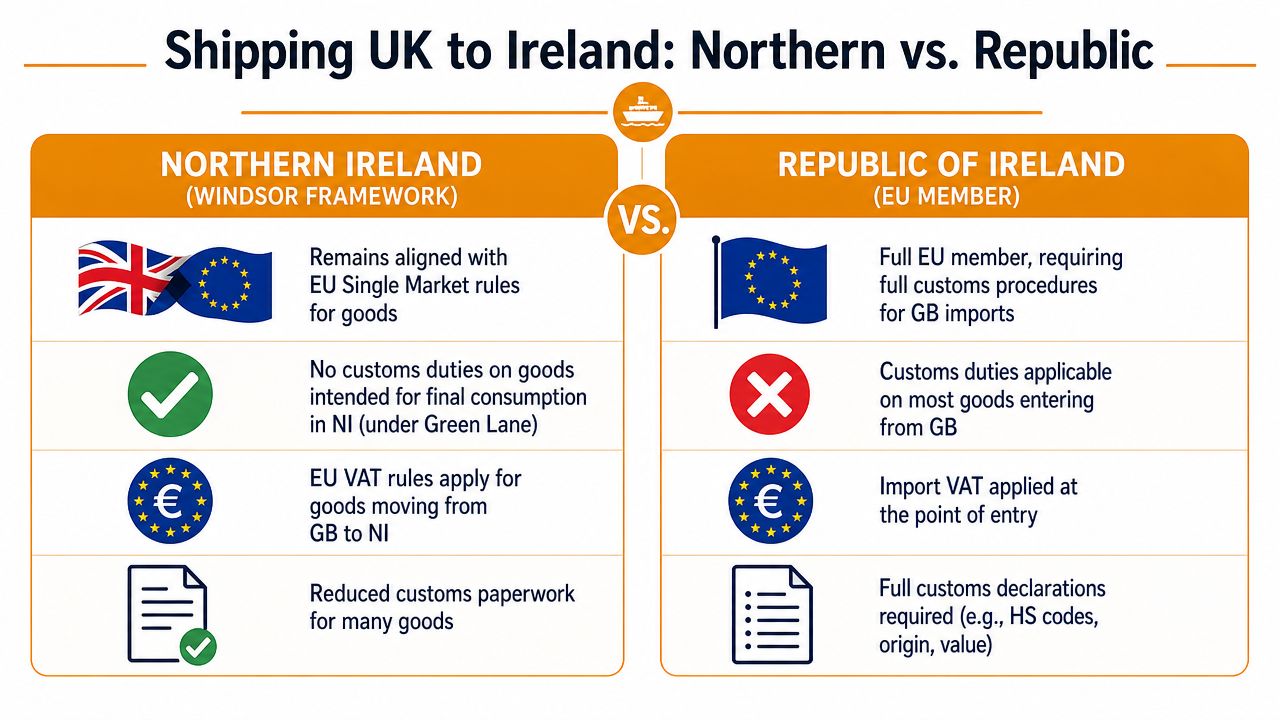
A short overview helps before going further:
Why operations teams merge them by mistake
Booking tools, carrier pages, and marketplace checkouts often reduce the island to one destination label. That shortcut causes avoidable errors. Transglobal Express's Ireland guidance notes that customs clearance is required for shipments between the UK and Ireland, while also stating that the rules are “a little different” for Northern Ireland.
In practice, “a little different” is enough to break a workflow if not given enough thought.
A parcel to Belfast does not follow the same process as a parcel to Dublin. If the destination logic is wrong at order entry, the shipment can be mid flight before anyone notices the paperwork is tied to the wrong regime.
Belfast and Dublin need separate operating rules
Keep this distinction visible in every shipping workflow, especially in relocation.
| Shipment factor | Republic of Ireland | Northern Ireland |
|---|---|---|
| Destination logic | Treated as shipment into an EU member state from Great Britain | Separate treatment applies and must be checked on its own terms |
| Customs treatment | Full customs compliance sits at the center of the shipment process | Requirements differ from Republic of Ireland movements |
| Paperwork risk | Missing invoice detail, classification, or payment setup can delay release | Errors often start with paperwork built using Republic of Ireland assumptions |
| Common process failure | Teams treat Dublin like a near-domestic export lane | Teams treat Belfast as if it follows the same rule set as Dublin |
Country fields say “Ireland” without forcing a choice between IE and Northern Ireland. Customer service confirms service availability without checking the exact destination. Finance or ops teams reuse one invoice template across both lanes. The shipment is held because the paperwork doesn't meet requirements.
What to change in your process
Build the destination split into the first step of the workflow, not the last.
Ask these three questions before label generation:
- 1
Is the shipment going to the Republic of Ireland or Northern Ireland?
- 2
What goods are moving, including any restricted or mixed-content items?
- 3
What paperwork and routing logic applies to that exact lane?
If your checkout, CRM, or booking flow does not force that destination choice early, staff will correct it late. Late corrections are where clearance charges, relabelling, and failed delivery promises start.
This distinction is one of the least well covered parts of public guidance on shipping to Ireland from UK operations. Speed is rarely the blocker. Classification and jurisdiction usually are. A shipment can be simple to book, physically close, and still be wrong on paper because the sender applied one rule set to two different destinations.
This distinction is especially important for relocation companies and C2C shippers. Mixed personal effects often pass through teams that know the route in general terms but have not built separate controls for Belfast and Dublin. That is where preventable delays begin.
Choosing Carriers and Understanding Realistic Timelines
Many organisations book transport first and think about customs second. That order makes sense only when the route is fully domestic. It doesn't work well here.
Transport speed versus clearance speed
The physical route between Great Britain and Ireland is short, and ferry geography still shapes real delivery performance. TIMOCOM's overview of UK-Ireland road freight notes common ferry corridors such as Holyhead to Dublin at about 2 to 3 hours, Fishguard to Rosslare at about 3 hours, and Liverpool to Dublin at around 8 hours. The same piece also points to the wider scale of Irish Sea freight, including 9.2 million tonnes of sea freight sent from Northern Ireland to Great Britain and 10.2 million tonnes received from Great Britain in 2023, with 56.6% of Irish Sea freight crossings between Northern Ireland and Great Britain and 43.4% involving Ireland to Great Britain movements.
The practical lesson is straightforward. Linehaul capacity is real, ferry schedules matter, and the route is heavily used. But none of that rescues a shipment that isn't customs-ready.
How to choose the right service
Carrier service levels vary sharply. Royal Mail's Ireland service guide says International Tracked & Signed and International Tracked aim for 3 to 4 working days, while International Economy can take up to 15 days. The same verified data set also notes that FedEx advertises next-day options for smaller parcels to Ireland, and that one drop-off service carries a 15 kg maximum weight.
That should change how you look at carrier options:
Postal services work well for lower-value parcels, less urgent deliveries, and flows where the recipient experience can tolerate variability.
Express couriers make sense for time-sensitive parcels, but they expose paperwork errors faster because the transport leg is no longer the bottleneck.
Freight forwarders and groupage providers are usually better for larger consignments where documentation and commercial coordination matter as much as transit.
A practical carrier selection process looks like this:
Start with the goods: Are they ordinary, restricted, fragile, or high-support?
Then check service compatibility: Weight, service limits, and carrier-specific acceptance rules matter.
Then test the paperwork standard: If your invoice quality is inconsistent, don't buy premium speed and expect premium outcomes.
Fast transport doesn't create fast delivery when customs is waiting on data the sender should have supplied at dispatch.
Operations teams often misread carrier transit claims because they treat them as end-to-end promises. They're usually transport targets, not guarantees against customs interruption. On this lane, realistic timing is always a combination of collection cut-off, ferry movement, carrier network performance, and documentary readiness. Operations teams that don't explain this to their customer service teams disappoint clients.
Automating Compliance and Avoiding Common Pitfalls
Teams rarely struggle with the same shipment twice for the same reason. They struggle because the same weak process keeps producing new variations of the same avoidable errors.
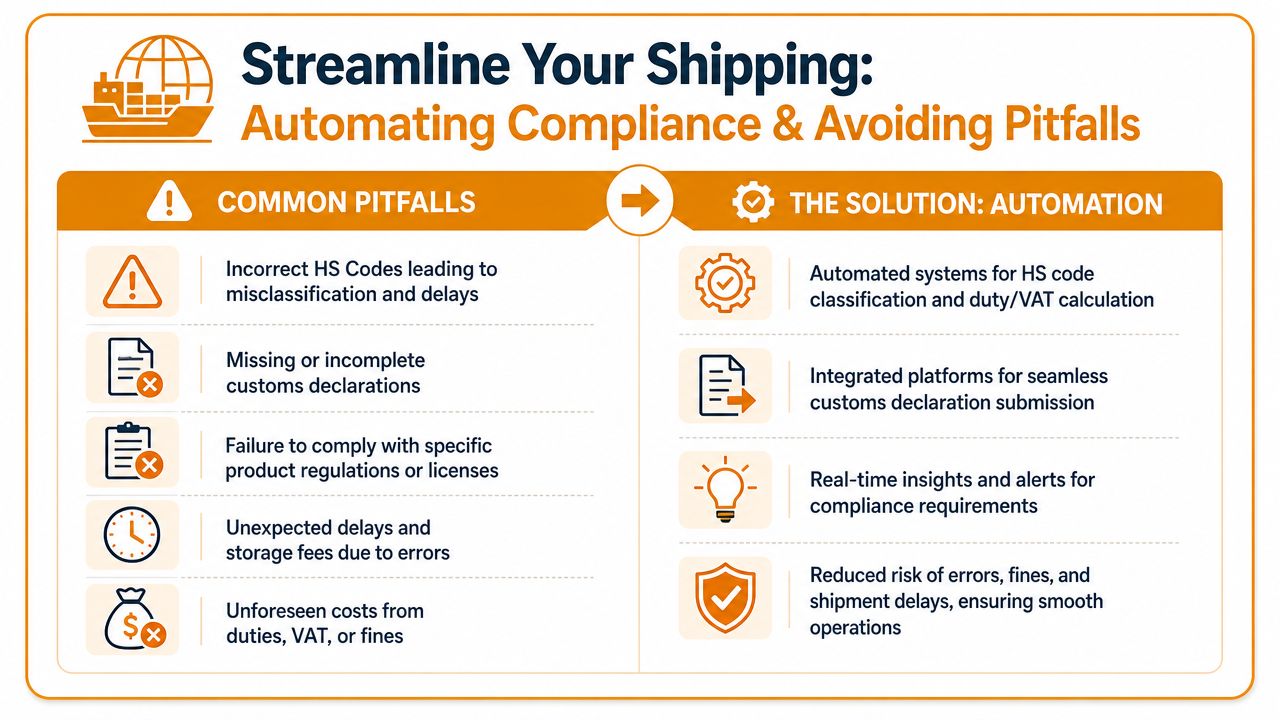
The errors that keep repeating
The most common operational failures on this route are familiar:
Wrong classification: The goods are described too briefly or mapped to the wrong code.
Missing detail: Invoice fields are incomplete, inconsistent, or copied from domestic templates.
Bad destination logic: Staff don't separate Northern Ireland from the Republic of Ireland early enough.
Restricted-item misses: Battery and liquid products fail carrier or customs screening.
Late payment decisions: DDP and DDU are treated as an afterthoughts rather than release controls.
These aren't specialist mistakes. They're normal outcomes when teams rely on manual memory, scattered carrier pages, and outdated internal notes.
Why manual checking breaks at scale
Manual checking feels cheaper until volume rises. One experienced operator can often spot a bad shipment before dispatch. That doesn't scale well across customer support teams, multiple carriers, marketplace listings, and new staff.
The breaking points are predictable:
Knowledge sits with a few senior staff
Rules change faster than SOPs are updated
Carrier restrictions differ from customs rules
Teams can answer simple cases but escalate edge cases too late
That's why operations teams increasingly move compliance checks earlier in the flow. They validate classification before booking, screen goods before document generation and standardise shipment data before labels are created.
A good automation layer doesn't replace judgement. It removes the repetitive uncertainty that causes preventable holds.
What works best is a system that checks the route, the goods, and the document requirements before someone commits the shipment. That's how you stop support tickets, returns, and customs rejections from becoming routine operating costs.
If your team is still piecing together customs answers from carrier pages, spreadsheets, and tribal knowledge, it's worth looking at Dutiful. Dutiful gives operations teams and developers verified customs intelligence before goods ship, including document requirements, restrictions, classification support, and route-specific compliance logic. You can view the product and join the waitlist for Dutiful Assist or explore the API for pre-checkout and pre-booking workflows.