How Long Does Customs Clearance Take? a 2026 Guide
How long does customs clearance take for used personal effects? Our 2026 guide covers timelines, common delays, and how to speed up the process.
Customs clearance can take 24 hours to several weeks. For used personal effects, the timeline depends less on a fixed clock and more on the shipment type, destination, and, most of all, how clean and complete the documents are.
That's why the most stressful message in relocation work is usually some version of the same question: Where are my things, and why is customs taking so long? The answer is rarely satisfying if you give it too early or too vaguely. A container of household goods isn't like a routine commercial pallet with repeat SKUs and standard brokerage data. Personal effects are messy. They're mixed, sentimental, often poorly inventoried, and frequently packed by someone who doesn't know that one undeclared bag of food, one wooden item with soil residue, or one missing form can turn a routine release into a hold.
For operations teams, the useful question isn't only how long does customs clearance take. It's what controls the timeline, what causes holds, and what can you fix before the shipment lands.
Table of Contents
The Question Every Client Asks 'Where Are My Belongings?'
A client has landed. Their new home is bare. Their child's school starts next week. Their used personal effects shipment is somewhere between the terminal and customs and they want one simple answer.
You usually can't give them one simple answer because there isn't one. Customs clearance can take 24 hours to several weeks, months in absolute worst case scenarios, and with household goods that range is normal. The shipment doesn't move through one universal timer. It moves through a chain of gates. If every document matches, the inventory is detailed and nothing in the load raises questions, clearance can move quickly. If any gate fails, the whole shipment waits.
That's the part junior teams often underestimate. Clients think customs delay means someone is slowly opening boxes or have just popped them to the side and forgotten them. Most delays happen much earlier, on paperwork, declarations, eligibility documents, or questions raised by the way the goods were described.
Practical rule:“Customs delays” in personal effects aren't caused by customs working slowly. They're caused by the shipment arriving with details that customs can't accept as submitted.
Used personal effects make this worse because they're rarely uniform. One shipment can contain clothing, books, kitchenware, baby equipment, electronics, framed art, wooden furniture, supplements, cosmetics, and food that “was probably forgotten in a pocket”. That mix creates compliance risk even before the container is opened.
A good ops team handles this before pickup, not after arrival. That means checking country-specific document and restriction requirements before the booking is final. If your team wants a faster way to do that, you can join the waitlist for Dutiful and review whether Assist or the API fits your workflow.
What clients actually need from you
Clients say they want a date. What they really need is a realistic range, a list of conditions, and confidence that someone has checked the weak points.
Give them three things:
A timing range: Explain that used personal effects can clear quickly when documents are accepted cleanly, but controlled items or document issues can extend the process.
A risk view: Tell them what specifically could slow their shipment. Food, wood products, plant material, alcohol, medicines, and vague inventories are common triggers.
A next step: Confirm what's already filed, what's pending, and what document would unblock the shipment fastest if customs asks a question.
That's how you calm the situation without pretending certainty you don't have.
What Really Happens at the Border
A family lands on Tuesday. Their shipment arrives on Thursday. By Friday, the client is asking why customs is "holding everything" when the documents were sent last week.
That usually means one of two things. The entry is still being worked through customs controls, or customs has finished and the shipment is waiting on a separate terminal, courier hub, or delivery release. For used personal effects, teams lose time when they treat those as the same step.
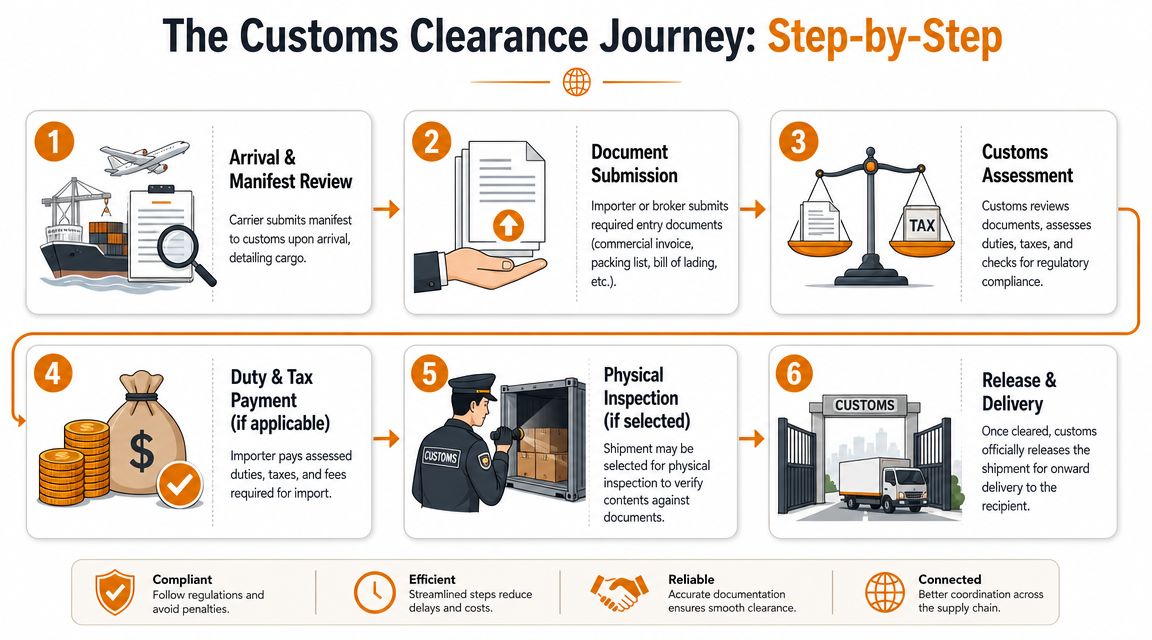
It starts before arrival
Border clearance for household goods is largely a document and risk-screening process first. The truck, air shipment, or container does not arrive and then begin from zero. Customs systems already have transport data, declaration data, and whatever supporting documents the broker or agent has filed.
In the UK, electronic declarations through CDS are now standard. The practical point for relocation teams is simple. If the inventory is vague, the relief basis is unclear, or the consignee documents do not line up and meet criteria, the shipment reaches the border with a problem already attached to it.
Personal effects also behave differently from ordinary commercial cargo. A commercial shipment may have one tariff line and repeat stock with a clear value. A household goods shipment can include used clothing, cookware, books, tools, children's items, framed pictures, wooden furniture, and a few restricted goods the shipper forgot to declare. That mixed profile is why a personal effects shipping requirements guide for relocation teams matters more here than a generic freight checklist.
The process usually runs like this:
- 1
Arrival is reported
The carrier submits arrival information and the shipment is matched to the transport record. - 2
The customs entry is lodged or activated
The declarant files the entry with the supporting documents. For personal effects, that often includes the inventory, specific forms, transport documents, passport copy, visa or residence evidence, and any transfer of residence or duty relief paperwork. - 3
Customs reviews the file
Officers or automated risk filters assess what was declared, whether relief appears valid, and whether anything needs a closer look.
Assessment, checks, and release
Here, timelines split in real life.
A clean personal effects file may pass with little friction. A file with broad descriptions, missing residency evidence, undeclared alcohol, food, plant material, untreated wood, medicines, or value questions is more likely to stop for a query or inspection. Used shipments get extra attention because the packing is less uniform and the inventory quality is often poor.
Clear entries move faster. "Used household goods" by itself is not a workable inventory description.
After the first review, the shipment usually goes through some or all of these stages:
Duty or relief confirmation: Customs confirms whether charges apply or whether a personal effects relief can be used.
Document query if something does not match: Customs or the broker may need clarification before the entry can proceed.
Physical exam if selected: Part or all of the shipment may be opened and inspected to verify contents against the paperwork.
Customs release: The goods are legally cleared from customs control.
Terminal, warehouse, or delivery release: The operator still has to make the shipment available for collection or onward delivery.
That last point causes a lot of bad client updates. A shipment can be customs cleared and still not be collectable that day. If your team reports "released" without checking which release happened, you create avoidable confusion, failed delivery bookings, and extra storage risk.
Typical Timelines for Personal Effects Shipments
For used personal effects, timing benchmarks are useful only if you treat them as planning ranges, not promises. The mode matters. The destination matters. The inventory quality matters even more.
Benchmarks by mode
Here's a practical way to set expectations for post-arrival customs clearance on personal effects when there are no obvious problems.
| Shipment Mode | Destination Region | Estimated Clearance Time (No Delays) |
|---|---|---|
| Air freight personal effects | Major hubs with routine processing | Often 24 to 72 hours |
| Sea freight personal effects | Major ports with routine processing | Often 3 to 10 days |
| Any mode with document queries or intervention | Any region | Can extend to several weeks |
These ranges are operational benchmarks used by relocation teams, never guaranteed service levels. They're most useful when you compare one shipment against another. Air freight usually clears faster because the loads are smaller and more tightly documented. Sea freight often takes longer because terminals, deconsolidation, inspections, and collection slots add friction even when customs itself isn't the blocker.
If you're handling household goods regularly, this guide to personal effects shipping requirements and planning is a useful companion for pre-move checks.
Cleared is not the same as collectable
One of the biggest misunderstandings in this whole topic is the gap between customs clearance and physical release. A shipment can be cleared on paper and still sit at the terminal because of downstream checks, handling queues, or release coordination. The UK's Border Target Operating Model changed when some documentary checks happen depending on the goods and route, which is a good example of why “cleared” doesn't automatically mean “ready for collection”, as outlined in this explanation of clearance versus release timing.
That distinction matters a lot in client communication.
Don't tell a consignee “your goods are cleared” unless you also know whether the terminal has actually released them for pickup or delivery.
For personal effects, think in three layers:
Customs accepted the declaration
All questions, charges, or controls are resolved
The goods are physically available to move
If you collapse those into one status, you create false expectations for the client and more inbound contact for your customer service team.
What changes the timeline fastest
A used personal effects shipment usually moves quickly when these conditions line up:
The packing list is itemised: “10 cartons used books”, “used men's cotton shirts”, “used kitchen utensils”.
The shipper has removed risky items: No hidden food, plant material, medicines, or restricted goods.
The consignee documents are ready: Residence, identity and any duty-relief paperwork are already in place.
The broker receives complete data before arrival: Not after customs starts asking questions.
When those conditions aren't met, the timetable stops being a range and starts being a troubleshooting exercise.
The Biggest Reasons Your Shipment Is Stuck
When a used personal effects shipment is held, people often blame customs, the courier, or the middle agent. Those things happen. But the biggest reason these shipments get stuck is much simpler: incomplete or inaccurate documentation.
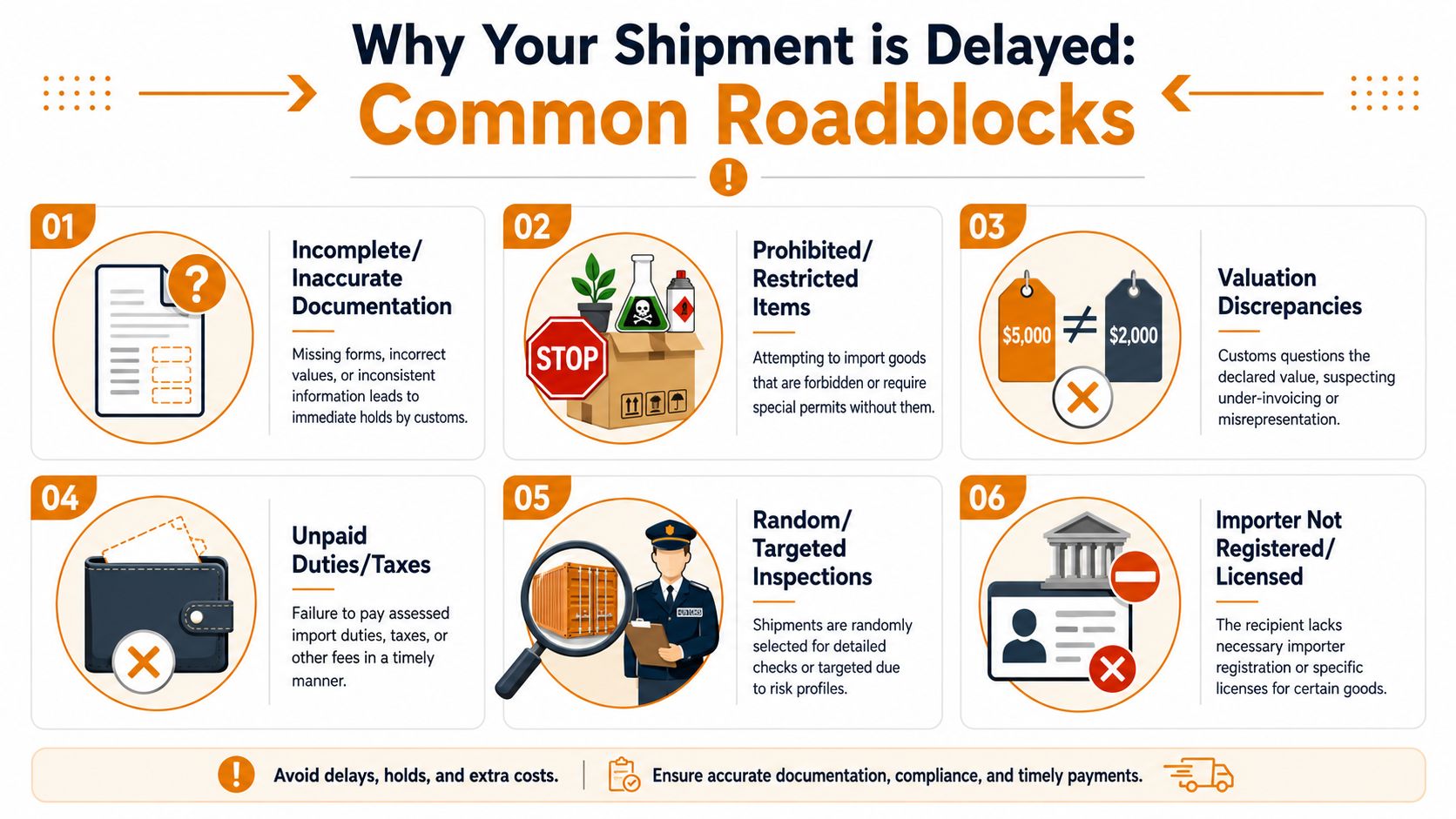
The biggest reason is bad paperwork
Used personal effects are especially vulnerable because people describe them casually. Customs doesn't work well with casual descriptions.
“Household items” is poor.
“Miscellaneous personal belongings” is worse.
“Kitchen items” can hide knives (prohibited via most couriers), food, wooden utensils (prohibited or requiring bio inspection), or electrical appliances.
The common paperwork failures look like this:
Vague packing lists: Boxes are listed by room rather than by contents.
Inconsistent values: The declared value doesn't match the age, condition, or type of goods.
Missing eligibility proof: Relief programmes for movers or returning residents often require specific supporting documents.
Mismatched names and dates: The shipper, consignee, passport details, and move documents don't line up cleanly.
A strong inventory doesn't need to be beautiful. It needs to be specific enough that a customs officer can understand what's in the load without guessing.
Here's a good operational habit. If a stranger could read the inventory and still ask “what is this item, exactly?”, rewrite it.
Used personal effects trigger extra questions
Personal effects also get held because they often include controlled goods without anyone realising it. Food, plants, wood products, and similar items can trigger sanitary or phytosanitary controls. These are risk-based, so the level of checking depends on the product and origin, which is why accurate declarations matter so much for these goods, as noted in this discussion of controlled goods and risk-based checks. This is after initial checks for courier related prohibited items such as liquids, which can instantly mean the return of disposal of a shipment.
That issue gets worse in mixed household shipments because one problem item can affect the whole consignment.
A few examples that repeatedly cause trouble:
Food and supplements: Even small quantities packed for personal use can trigger questions.
Plants and plant material: Dried herbs, seeds, decorative plant items, and garden products can all matter.
Wood products: Wooden furniture, carvings, and untreated wood can draw closer scrutiny, especially if description is poor.
Alcohol and medicines: These often need clearer declaration and sometimes additional paperwork. Alcohol is not eligible for duty relief.
Dirty outdoor goods: Camping gear, bicycles, prams, and garden tools with soil or organic residue can create biosecurity concerns.
For classification work on odd household items, teams often need a quick way to understand how customs will interpret an item category. This article on what an HS code is and why it matters helps junior staff avoid broad, unhelpful product labels.
A short explainer can help newer coordinators spot the main delay categories before they become expensive.
What about rejected or disposed shipments
There isn't a verified global statistic for how many used personal effects shipments are disposed of or rejected due to prohibited items or incomplete documents, so don't promise a percentage to clients and don't build internal forecasting around made-up numbers.
What you can say, accurately, is this: when documentation problems or prohibited-item issues aren't resolved, some shipments are abandoned, returned, destroyed, or disposed of at the owner's expense. In practice, that usually happens because storage and handling charges keep increasing while the shipment remains non-compliant. We've seen every example.
The expensive part isn't always the customs hold itself. It's the time spent failing to fix the reason for the hold.
That's why prohibited items matter so much in used personal effects. One undeclared restricted item can convert a normal household move into a multi-party exception case involving customs, the courier, the agent, and the consignee. By the time everyone agrees on a solution, the avoidable costs are already there.
An Operations Checklist for Faster Clearance
Faster clearance starts days before arrival. In personal effects, the file quality usually decides whether customs treats the shipment as routine household goods or as a mixed-load problem that needs questions, holds, and extra documents.
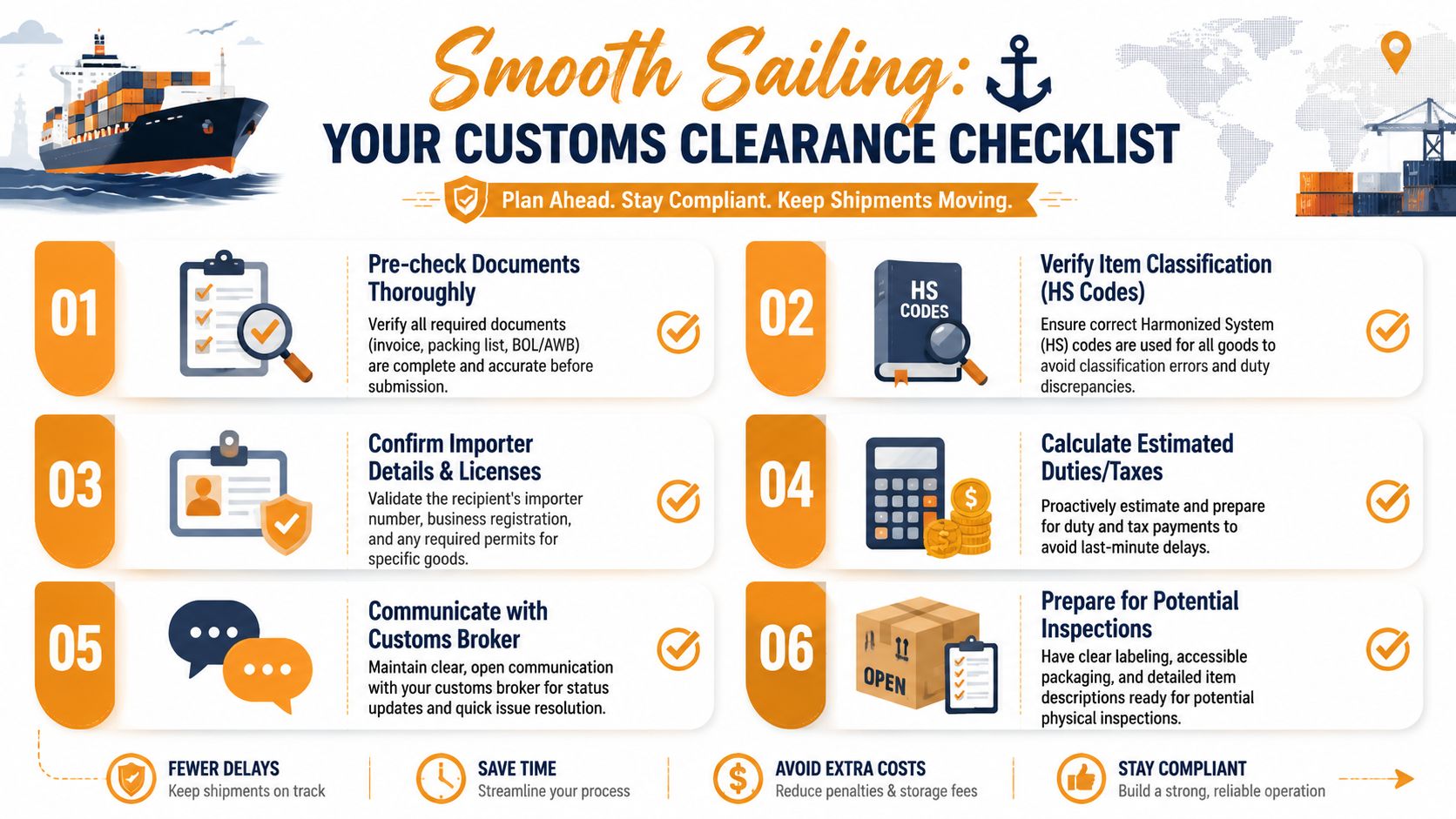
The habits that keep shipments moving
Strong teams treat personal effects files like exception screening. They do not assume a household shipment is low risk just because it is not commercial cargo.
Use this checklist:
Reject broad labels early: If the list says "misc", "decor", "toiletries", "garage items", or "pantry items", return it for detail before filing.
Ask about restricted goods by category: Ask directly about food, alcohol, medicines, supplements, liquids, seeds, candles, animal products, cleaning chemicals, weapons-related items, and untreated wood.
Match names across the file: Passport, booking, bill of lading, declaration, and consignee details should line up exactly. Small mismatches create avoidable queries.
Flag goods that need extra review: Antiques, artwork, high-value electronics, professional tools, stamp collections, and hobby equipment often need clearer descriptions or supporting papers.
Decide early whether a broker should handle the entry: Some routes are straightforward. Others are not. Personal effects relief claims, mixed contents, and stricter destination controls often justify specialist handling.
Keep one current rules source: Delays multiply when one coordinator follows an old SOP and another relies on memory, and updated customs rules go unnoticed.
One practical option is Dutiful, which provides verified customs intelligence through Assist and an API so teams can check up to date documents, restrictions, and route requirements before shipping. It is most useful when operations staff need consistent answers across multiple destinations and do not want country rules living only in senior staff inboxes.
Good client communication belongs in the checklist too. Give ranges instead of promises. Put risk items in writing. For personal effects, that single step prevents a familiar problem. The shipment is under review, the client thinks customs is slow, and the underlying issue is that nobody warned them their "used household goods" included items that border agencies do not treat casually.
Taking Control of Your Customs Timeline
Used personal effects shipments don't fail because customs is impossible. They fail because too many teams treat them like informal cargo or don't understand their complexity. They're regulated shipments with mixed contents, variable relief rules, and a high chance of trouble if the paperwork is weak.
So, how long does customs clearance take? It can be fast. It can also drag on for weeks. The deciding factor usually isn't luck. It's whether the shipment arrives with enough accurate information for customs, border agencies, and the terminal to do their jobs without stopping to ask basic questions.
That changes how you manage the work.
Train teams to build detailed inventories. Challenge vague descriptions. Ask blunt questions about food, wood, medicines, and plant material. Confirm relief documents before departure. Separate “customs cleared” from “physically released” in every client update. Those habits do more for timeline control than any amount of chasing after arrival.
The operations teams that handle this well don't just reduce delays. They reduce stress, storage exposure, rework, and avoidable arguments with clients.
If you want fewer customs surprises, Dutiful gives your team a way to check documents, restrictions, duties, and route-specific requirements before goods move. That makes it easier to catch the issues that slow personal effects shipments down, especially when your team is handling multiple destinations and exception-heavy moves.